
Nombre del autor:Elena Dominguez

Marketing and Sales Manager at Zeulab. Expert in food safety.

allergen-test-processed-foods
Allergens

Are you using the right test to detect allergens in processed foods?

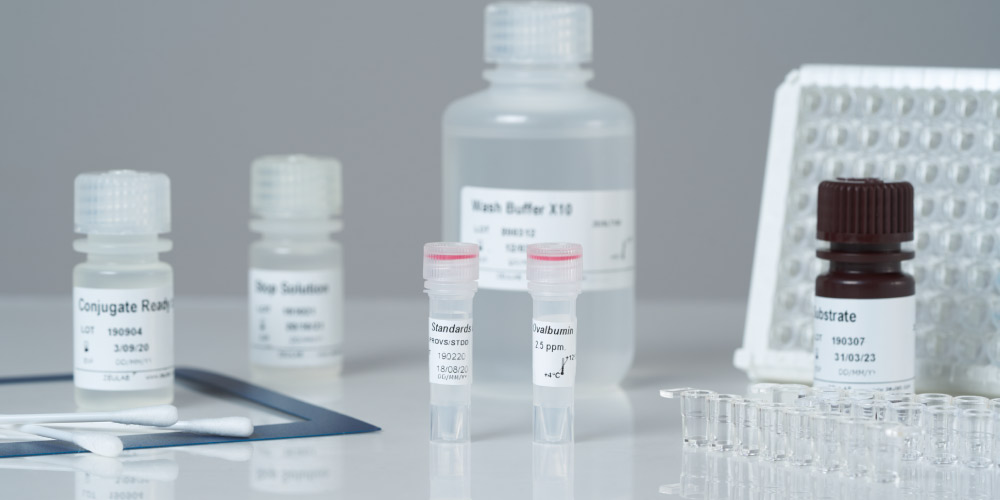
Food allergens are proteins with very different physical and chemical properties and size. Some processes, such as fermentation, hydrolysis or high heat treatment, can alter their chemical structure and reduce their allergenic properties, although not completely eliminating them. These treatments can also, therefore, affect the detection capacity of allergen tests. The methods commonly used for the analysis of food allergens are based on the specific union between the allergen (antigen) and an antibody (IgG), obtained specifically for the allergenic protein to be detected. These tests, called immunoassays, can be in rapid strip formats or ELISA tests. The strip format tests are easy to perform by any operator, without the need for specific materials or equipment, and can identify a trace presence in a few minutes. Their use in the analysis of contact surfaces during food production or in controls for the processed product helps to ensure proper labelling. ELISA tests are more laborious to carry out, but quantify the amount of allergen in the sample, and so can be used in production line cleaning validation or in final product analysis. Soy, egg or milk proteins, among others, are added to foods such as meat, bakery and pastry products to provide texture, flavour or the characteristic appearance of the product. High heat treatment prolonged for hours makes it difficult to detect traces of these allergens. Processing conditions vary according to the food or manufacturer, so it can be difficult to ensure that the test is detecting the allergen properly in the treated product. Therefore, the allergen test needs to be validated for a specific product and treatment, to ensure allergen control is effective. If not, you may have a control system in place, with its attendant investment in time and money, but you could be breaking the regulations or even triggering a food alert. Recently, our Zeulab team helped a customer optimise its soy detection test in a meat product that was heated for several hours. Following the development of a specific additive added to the extraction buffer, the detection level of the assay was improved 10-fold. At Zeulab, we can assess whether the test sensitivity is appropriate for the levels of allergens present in your product after heat treatment, and perform a personalised study to modify the sample preparation procedure to ensure greater extraction of the allergen. Leer más Rápidos Lab2GO Leer más Leer más Rápidos Proteon Egg Express Leer más Leer más Rápidos Test de alérgeno de leche: Proteon Duo Milk Express Leer más [button target="_self" hover_type="default" font_weight="400" text_align="center" text="Discover Zeulab's complete portfolio of allergen control" link="https://www.zeulab.iatic.es/en/alergenos/"] Related articles: [latest_post type="boxes" number_of_colums="4" number_of_rows="1" text_from_edge="yes" order_by="date" order="DESC" title_tag="h4" display_time="1" display_comments="0" display_like="0" display_share="0" category="Alergenos" text_length="0"]
test-adecuado-detectar-alergenos-alimentos-procesados
Alérgenos

¿Estás utilizando el test adecuado para detectar alérgenos en alimentos procesados?

Los alérgenos alimentarios son proteínas con propiedades físico-químicas y tamaño muy variado. Algunos procesos como la fermentación, hidrólisis o tratamientos térmicos elevados podrían alterar su estructura química disminuyendo su capacidad alergénica, aunque no eliminarla por completo. Por tanto, estos tratamientos pueden también afectar a la capacidad de detección de los test de alérgenos. Los métodos comúnmente usados para el análisis de alérgenos alimentarios se basan en la unión específica entre el alérgeno (antígeno) y un anticuerpo (IgG), obtenido específicamente frente a la proteína alergénica a detectar. Estos test, llamados inmunoensayos, pueden ser en formato de tira rápida, o test ELISA. Los test en formato tira son sencillos de realizar por cualquier operario, sin necesidad de materiales o equipos específicos, identificando la presencia de trazas en tan solo unos minutos. Su uso en el análisis de superficies de contacto durante la producción del alimento o en el control del producto elaborado ayudan a asegurar el correcto etiquetado. Los test ELISA, más laboriosos de realizar, permiten cuantificar la cantidad de alérgeno presente en la muestra y pueden ser utilizados en las validaciones de limpieza de las líneas de producción o en el análisis del producto final. Las proteínas de soja, huevo o leche, entre otras, se añaden a alimentos como productos cárnicos o de panadería y repostería proporcionando la textura, sabor o aspecto característico del producto. Los tratamientos térmicos elevados y prolongados durante horas dificultan la detección de trazas de estos alérgenos. Las condiciones del procesado varían según el alimento o fabricante, de modo que puede resultar difícil asegurar de forma genérica que el test usado esté detectando correctamente el alérgeno en el producto tratado. Por tanto, antes de nada, es necesario verificar tu test de alérgenos en tu producto y tratamiento concreto para asegurar que tu control de alérgenos resulta efectivo. De lo contrario, a pesar de tener implantado un sistema de control que requiere inversión de tiempo y dinero podrías estar incumpliendo la normativa o incluso se podría generar una alerta alimentaria. Recientemente, nuestro equipo de Zeulab ayudó a un cliente a optimizar su ensayo para la detección de soja en un producto cárnico sometido a calentamiento durante varias horas. Gracias al desarrollo de un aditivo específico añadido al tampón de extracción, el nivel de detección del ensayo mejoró 10 veces. En Zeulab podemos evaluar si la sensibilidad del test se ajusta a los niveles de alérgeno presentes en tu producto tras el tratamiento térmico, haciendo un estudio personalizado y adaptando el procedimiento de preparación de la muestra para obtener una mayor extracción del alérgeno. Leer más Rápidos Lab2GO Leer más Leer más Rápidos Proteon Egg Express Leer más Leer más Rápidos Test de alérgeno de leche: Proteon Duo Milk Express Leer más [button target="_self" hover_type="default" font_weight="400" text_align="center" text="Descubre la línea completa de Zeulab para el control de alérgenos" link="https://www.zeulab.iatic.es/alergenos/"] Artículos relacionados: [latest_post type="boxes" number_of_colums="4" number_of_rows="1" text_from_edge="yes" order_by="date" order="DESC" title_tag="h4" display_time="1" display_comments="0" display_like="0" display_share="0" category="Alergenos" text_length="0"]
Scroll al inicio